
AI workslop: five risks charity leaders are seeing and what we can all learn from this and do about them today
AI is already everywhere in our organisations. The question for leaders now is whether it’s making our work better, or just making more of it.
Most of us are now using AI at work. The Charity Digital Skills Report 2026 found 79% of charities are using AI tools, and 71% of UK employees have used AI tools their employer hasn’t approved, and 51% do so every week (Microsoft UK and Censuswide 2025). So the use is happening, whether or not we’ve planned for it.
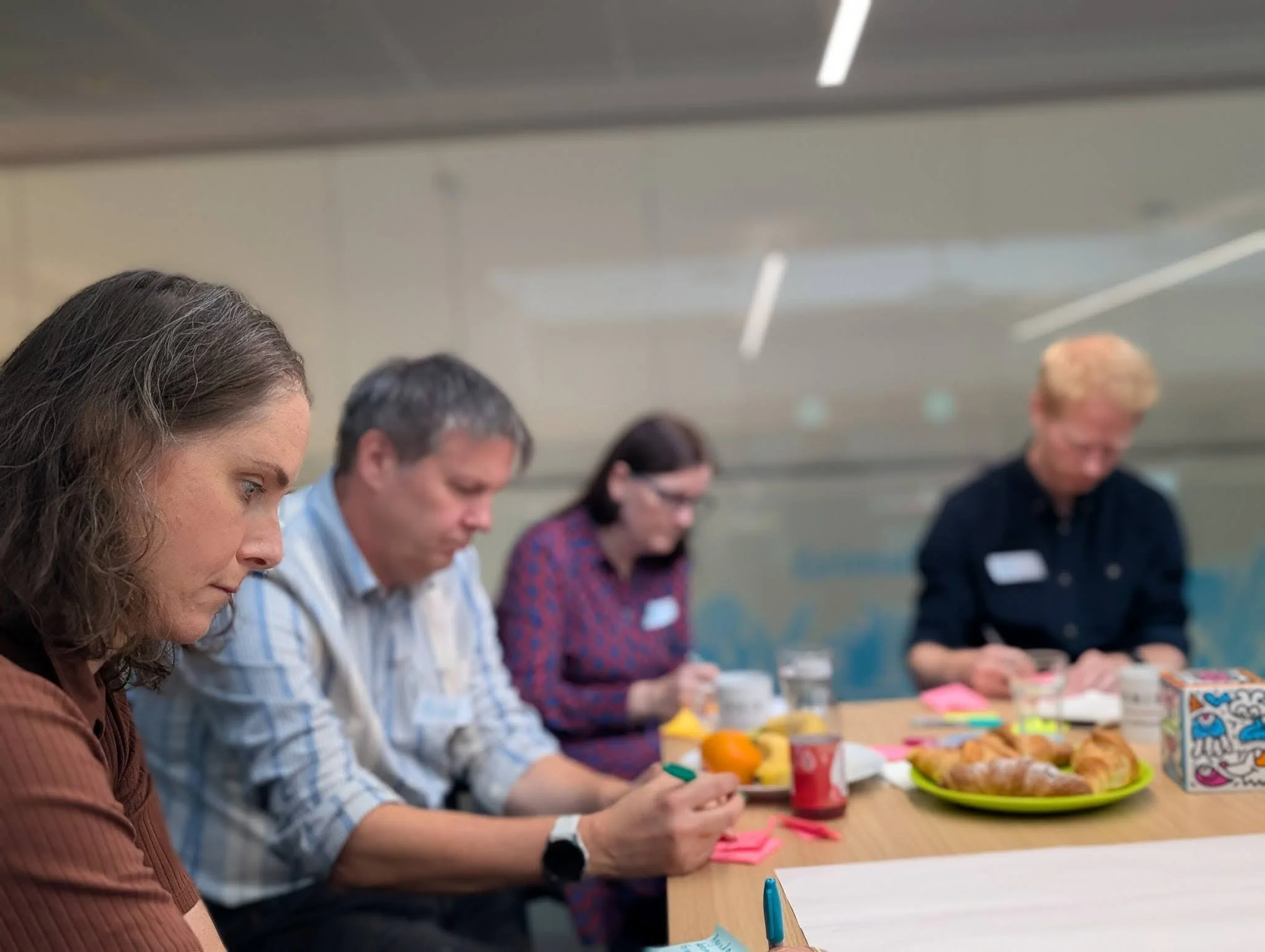
As my Collective colleague Julius Honnor put it at our event, slop has always existed. But a 20-page report that said very little used to take weeks to write. That effort meant we only wrote one when it really mattered, and the slow process gave us time to think, check and improve it as we went. Now, using AI, it takes an hour. There may be an important idea in there, but often nobody has spent the time to sense-check and develop it, or the AI was given poor data or directions to start with. So what comes out simply isn’t robust.
When AI isn’t guided by a clear direction, a clear question to answer and good data, it fills the gaps with workslop: documents that look finished but aren’t, analysis nobody has checked, poor references, fluff instead of ideas. It takes time to read, time to consider and time to check and fix. Rather than saving us time, it’s eating up much of the little time and resources we have.And so it isn’t making us more efficient, as so many of us hoped it would.
Is this another case of the emperor’s new clothes? A little, yes. We are getting things that look great but often there is not much underneath (polished turds, anyone?). But is this wholly AI’s fault? No. It’s up to us to make more of the new technology. It’s not going away. We can bury our heads in the sand and hope it does (I know a fair few of us have), but with such high usage across the sector, endorsed or not, we should be giving people guidance on how to use it well (spoiler alert: that’s what the second half ot is blog is about).
And what good looks like is what it has always been. It’s about clarity: of direction, of the question that needs answering and the problem that needs solving. It’s about feeding in quality data and insight. And it’s about sense-checking before we “waste” anyone’s time with a half-formed thought, however beautifully presented.
As always, this is about quality over quantity. AI could give us the best of both, but right now it often doesn’t or worse, does the reverse. This is the same digital maturity problem many organisations already had. AI just makes it bigger.
The roundtable
In October, the Charity Change Collective brought charity CEOs and directors together for The price of inaction, a roundtable on AI workslop. The organisations in the room ranged from animal welfare to international development, health to climate action, with CEOs alongside leaders from policy, fundraising and operations.
Despite differences in size and cause, leaders were grappling with many of the same AI and transformation challenges.
We worked in two rotating groups to build risk registers, exploring the risks, how likely they are, and what we can do about them. This reflects the discussions at my table, where half a dozen leaders shared their experiences. Here’s what the output was:
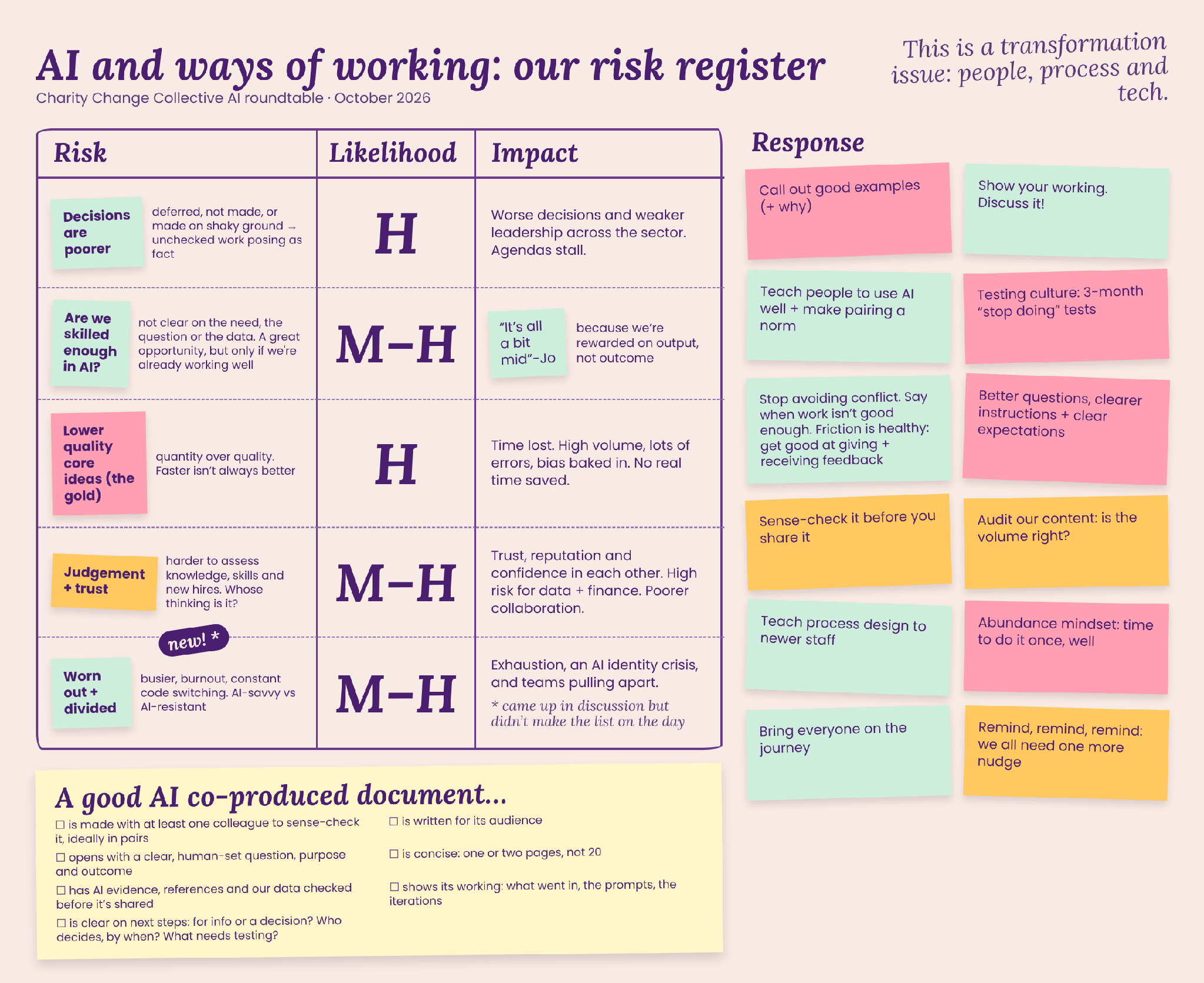
Five things that could go wrong with AI (and what we can do about them)
1. We're making it harder to make good decisions (likelihood: high)
We're putting decisions off, making them on shaky evidence, or not making them at all. And when something AI has produced looks convincing, it can be surprisingly hard to tell whether the thinking behind it stacks up.
Someone shared a story about someone receiving a paper that looked great, only to discover that its author couldn't actually defend the arguments in it. That's a problem. If we can't trust the thinking behind the paper, how are we supposed to make a good decision based on it?
The risk is that we end up with more information, more documents and less clarity about what to do next.
2. We're not very good at getting the best out of AI (likelihood: medium to high)
AI can do some brilliant things. But it needs good questions, useful data and a bit of skill from the person using it. Too often, those ingredients are missing. As one person put it, a lot of what we're getting is "all a bit mid".
That's not necessarily a problem with the technology. It's also about how we work. If we reward people for producing things rather than achieving something useful, why would we expect AI to change that? Nick Scott and the Charity Change Collective's thinking on AI transformation makes a similar point. Knowledge management is, in part, "data quality for unstructured content". If your information is a mess, AI isn't going to magically sort it out for you.
3. We're making more stuff, but not necessarily better stuff (likelihood: high)
This is the workslop problem. We can produce more content, more quickly, but that doesn't mean we're producing more value. Our core ideas, the gold, risk getting lost in a growing pile of output. Errors and bias creep in. And the time we thought we'd saved gets eaten up checking, correcting and making sense of it all. Nick Scott shared research that showed that it can take nearly two hours to sort through workslop. And workslop can take only a few minutes to produce. So much for the productivity gains.
4. It's getting harder to know who, and what, to trust (likelihood: medium to high)
When applications, emails and reports are all AI assisted, how do we know whose thinking we're actually seeing? That has real consequences. Recruitment is one obvious example, with AI increasingly assessing work that AI may have helped produce in the first place.
There are wider risks, too. Reputations can be damaged, and mistakes in areas such as data and finance can have serious consequences. We need to think carefully about where we trust AI, where we need human judgement, and how we tell the difference.
5. We're getting more exhausted, and our teams are pulling apart (likelihood: medium to high)
This came up again and again in our discussion, even though it didn't make our original risk register. For some people, AI is creating more work, not less. There's more to review, more tools to navigate and more switching between tasks. It's exhausting. Meanwhile, teams are starting to divide into those who are enthusiastic about AI and those who are wary of it, or simply don't want to use it.
Our thinking on AI transformation anticipated this. AI isn't just a question of learning new skills. It's a question of identity, too. As the paper puts it, one of the deepest questions is: "who am I professionally, when AI does part of what I did?" A training course won't resolve that. We need to make space for the conversations and redefine where we bring the most value.
So what can leaders actually do?
Here's the good news: Most of the answers aren't about buying better AI tools or sending everyone on another training course. They're about how we work together.
Our discussion with charity directors and CEOs pointed to three things leaders can influence: what you ask for, what you reward and what you invest in.
What you ask for
Be clear about what you want. Give people, and AI, a clear question to answer, a purpose to work towards and an outcome you're looking for.
Ask to see the working. What went in? What prompts were used? What changed along the way? Don't just look at the finished product. Talk about how it got there.
Build in a sense check. Before anything is shared, someone needs to check that it makes sense, the evidence stacks up and the content is fit for purpose. Whoever sends it owns that responsibility.
What you reward
Celebrate the good stuff, and explain why it's good. Help people understand what useful, thoughtful work actually looks like.
Get comfortable with a bit of friction. If something isn't good enough, say so. Giving and receiving honest feedback is part of doing good work, not a sign that something has gone wrong.
Make room to do things properly. Rushing out more work because everyone's under pressure rarely makes things faster in the long run.
Keep repeating yourself. We're all going to need reminding. Changing how we work takes more than one announcement or a slide in a team meeting.
What you invest in
Get people working in pairs. Learning to use AI well is easier when you have someone to think with, challenge your assumptions and sense check the result.
Teach people how to design processes, not just use tools. This is particularly important for newer staff, who may have less experience of how the work fits together.
Take a look at what you're producing. Are you creating the right pieces of content, in the right amount? Or are you churning out content because that's what makes you look busy or moves work on meaningfully?
Experiment with stopping things. One organisation described choosing something, such as a regular meeting, and stopping it for three months. If nothing goes wrong, they keep the time.
Bring everyone along. Make space for people who are excited about AI, those who are sceptical and those who are worried about what it means for their role. Name the identity question rather than pretending it's just about training.
Our AI anti-slop checklist: make this the norm
We created this checklist together. Make it the norm for anyone using AI in your organisation, and encourage people to be open about when and how they've used it. Ask them to share what worked, what didn't and what they'd do differently. That's how we all get better.
Start with purpose. Be clear about the question, audience and what this is for.
Keep it concise. One or two pages where possible, not 20 when two will do.
Check the evidence. Verify facts, references and data before sharing.
Show your working. Be open about how AI was used, what you asked it and how the output was developed.
Sense check with a colleague. Ideally, work together from the start.
Make the next step clear. Is it for information or a decision? Who needs to decide, and by when?
Share what you learn. What was useful? What was rubbish? What would you change next time?
And remember the basics of good internal content: put the most important thing first, make it easy to skim, include only what's needed and make it easy to find again.
AI is a transformation challenge, not a tech rollout
AI didn't invent workslop, poor decisions or siloed working. It exposes the problems we already have and can multiply them at speed. If our strategy, processes, data or culture aren't right, AI won't fix them for us.
We've learned from ‘the digital transformations’ we went through over the last decade that technology alone doesn't solve people and culture problems. Let's not repeat the same mistakes, only faster.
The opportunity is bigger than getting people to use AI. It's about rethinking how we work, what we produce and how we make decisions together so we benefit from this rather than makes matters worse.
Three questions to take back to your organisation
Are we rewarding useful work or just work that looks impressive? Are we focused on outputs or outcomes and impact?
Who's responsible for how we work? Including the systems, processes and knowledge behind our use of AI.
Are we making the most of the opportunity? Could AI help us think better, do more useful work and collaborate more effectively, rather than simply produce more?
What's next from us
We have more coming soon. We're running another event in December, and we'll be in touch about it shortly. If you’re interested, make sure to sign up below.
We're also building a free AI tool for the sector, following our free toolkits on skills, culture, strategy and data. It will support organisations through this transformation challenge with hands-on tools, frameworks and simple things to try.
